Cackling Stump
The Tales of Beedle the BardThe Cackling Stump is the remnant of the tree that conceals Babbitty Rabbitty during her escape from the king’s witch-hunters. Though the king’s court believes the tree has been cut down with her in it, Babbitty’s voice rises from the stump, turning a supposed execution into a public reckoning: the charlatan is exposed, the king promises to protect witches and wizards, and the stump becomes the base for a golden statue of Babbitty. Its survival and continuing laughter give the story’s apparent ruin a double meaning: the tree is felled, but the witch is not defeated, and the stump becomes a monument to a change in the kingdom’s laws and conduct.
From Hiding Place to Stump
Babbitty takes refuge in the bush while the king attempts to demonstrate his newly acquired magic. When the charlatan blames her for the failure of the king’s spells, the king and his court pursue her with the Brigade of Witch-Hunters and its hounds. She reaches a low hedge and vanishes from sight. On the far side, the pursuers find the hounds gathered around a bent, aged tree. The charlatan insists that Babbitty has turned herself into the tree and urges the king to cut it down, hoping to prevent her from returning to human form and exposing him.
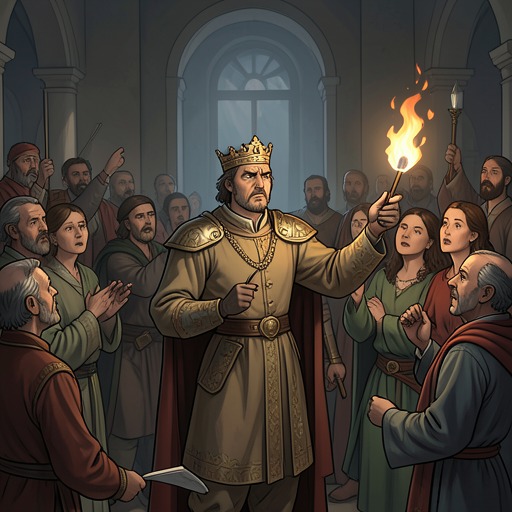
The king’s party has the tree felled, and the courtiers and charlatan cheer. But the triumph lasts only until they prepare to return to the palace: loud cackling halts them. The voice comes from the stump they have left behind. The apparent evidence that Babbitty has been destroyed is thus overturned at the precise moment the court is ready to treat its violence as a victory. The stump is no longer merely what remains of the tree; it becomes the place from which the supposed victim can speak and challenge her persecutors.
The Stump’s Accusation
Speaking from the stump, Babbitty tells the crowd that a witch or wizard cannot be killed by being cut in half, then invites the king’s followers to test the claim on the charlatan they have just called the Grand Sorcerer. The Captain of the Brigade of Witch-Hunters is ready to make the experiment. Faced with the prospect, the charlatan falls to his knees, begs for mercy, and confesses his deception. He is taken away to the dungeons while the stump laughs more loudly. Its voice has changed the balance of power: the witch-hunters’ readiness to use violence turns against the fraud whose scheme helped bring them there.
Babbitty then tells the petrified king that cutting down a witch has unleashed a curse on the kingdom. From that point onward, she says, each harm inflicted on witches and wizards will feel to the king like an axe stroke in his own side, until he wishes he could die. The threat gives the king an immediate personal stake in the persecution he authorized. He falls to his knees and promises to issue a proclamation protecting every witch and wizard in the kingdom and allowing them to practise magic in peace.
A Memorial and a Changed Kingdom
Babbitty does not allow the king’s promise to stand as the only redress. The stump insists that he must also make amends to Babbitty herself, identifying her as the kingdom’s poor washerwoman and demanding a statue of her upon the stump. The statue is to preserve her memory and remind the king, permanently, of his folly. He agrees at once and promises a statue made of pure gold by the foremost sculptor in the land.
The memorial’s position matters: the golden figure is to stand directly upon the stump left by the king’s order to fell the tree. A site of attempted destruction becomes a public marker of the woman the king wronged, and the court’s cheers for the tree’s fall give way to a promise to honor its supposed victim. After the shamed king and the nobles return to the palace, the stump is left cackling behind them. Its laughter accompanies the court’s retreat, while the promised memorial fixes the consequence of the encounter in the kingdom’s grounds.
Babbitty’s Escape and the Stump’s Legacy
Once the grounds are deserted, a stout, whiskery old rabbit wriggles from a hole between the stump’s roots, with a wand clamped between her teeth. Babbitty hops away, showing that she was never the tree the court cut down. The king’s party had destroyed the tree but not the witch; the stump’s voice had kept the court occupied long enough for the deception to be exposed and for Babbitty to escape.
Ever after, a golden statue of the washerwoman stands on the stump, and no witch or wizard is persecuted in the kingdom again. The object therefore carries two linked outcomes: it records the king’s failure to suppress magic and commemorates the end of the persecution he had set in motion. Its cackling also preserves the story’s reversal in miniature. The king’s court leaves believing it has felled its enemy, but the stump remains, Babbitty is free, and the kingdom’s treatment of magical people has changed.